Selecting the right way to hold your pages together determines how a customer interacts with your brand. It is not about aesthetics alone. The physical build of a catalog influences shelf life, shipping costs, and ease of use during a sales pitch. When you evaluate various catalog binding options, you must balance the total page count against the intended environment of the book.
High-end showrooms require different structural integrity than a greasy automotive shop floor.
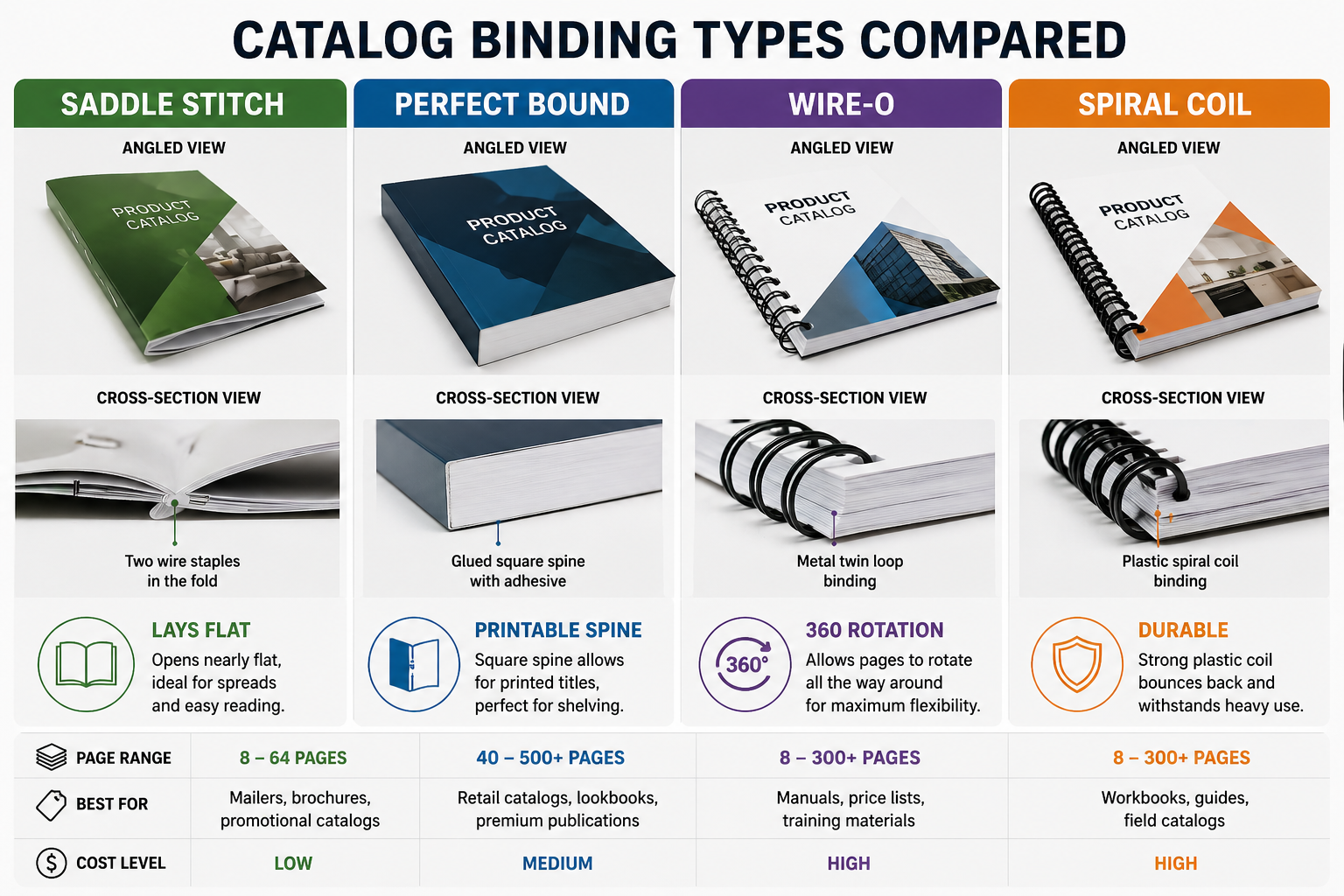
| Binding | Works Best With: | Notes: |
| Saddle Stitch | 8 to 64 page | Uses two wire staples along the spine |
| Perfect Bound | 40 to 500+ pages | Square spine with PUR adhesive |
| Wire-O | 8 to 300+ pages | Allows 360-degree rotation |
| Coil/Spiral | 8 to 300+ pages | Durable plastic for frequent handling |
Saddle stitching remains the industry standard for lightweight mailers. We use high-grade wire staples to secure folded sheets together. This method allows the catalog to lie nearly flat, which is vital for double-page spreads where images cross the gutter. If your page count exceeds 64, the “creep” becomes a factor. This is where the inner pages protrude further than the outer pages, requiring a face trim that can cut into your margins.
Why Perfect Bound Catalogs Command Authority
Perfect binding involves grinding the spine of the page signatures and applying a thermal glue to attach a wraparound cover. Standard PUR glue (polyurethane reactive adhesives) provides a flexible yet incredibly strong bond. This prevents pages from falling out even with repeated use in high-traffic retail spaces.
- Minimum spine thickness of 0.125 inches required.
- Uses 10pt or 12pt heavy cardstock for covers.
- Provides a printable square spine for library storage.
- Ideal for catalogs with 50 or more pages.
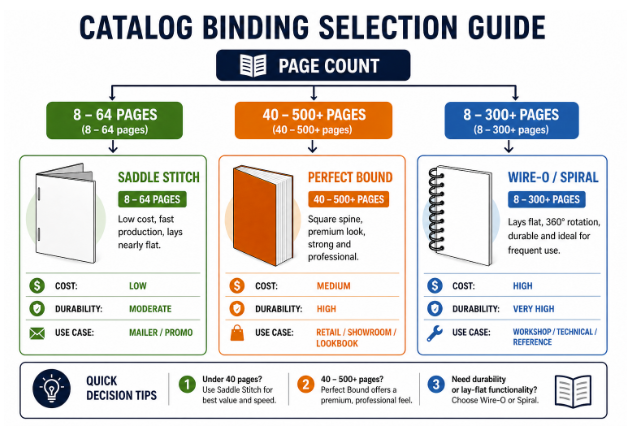
If the spine is too thin, the glue cannot “surface area” properly. This results in a weak hinge. For catalogs under 40 pages, saddle stitching is the better technical choice. Perfect bound books look like high-quality magazines. They signal to the customer that the content inside has lasting value. We see many Los Angeles fashion brands choose this for seasonal lookbooks because it mimics the feel of a retail boutique publication.
Functional Benefits of Wire-O and Spiral Binding
Some catalogs need to survive the “fold back” test. If a contractor needs to keep a catalog open to a specific parts page while working, a bound spine is a hindrance. Wire-O uses a twin-loop metal wire that looks professional and sleek. It is the preferred choice for technical manuals and price lists.
If the environment is rugged, then plastic coil is the winner. Plastic spirals do not lose their shape if stepped on or crushed in a tool bag. They bounce back. We offer various diameters to accommodate different thicknesses. The punch pattern for these catalog binding options takes up about 0.25 inches of the inner margin. You must ensure your design does not place critical text or “the money problem” (pricing tables) too close to that edge.
Comparing Durability and Unit Pricing
Cost per unit fluctuates based on the complexity of the machine setup. Saddle stitching is the fastest to produce. We can run thousands of booklets an hour on our automated lines. Perfect binding requires a curing time for the glue, which adds a day to the production cycle.
Some things to consider:
- Saddle Stitch: Lowest cost, fastest turnaround, best for direct mail.
- Perfect Bound: Medium cost, premium feel, best for high page counts.
- Wire-O: Higher cost, maximum utility, best for reference guides.
If your budget is tight, then stick to saddle stitch. If you want the book to stay on a coffee table for six months, then perfect bound is the way to go. We often see clients try to save money by choosing a lower-GSM paper for a thick catalog. This is a mistake. Thin paper in a perfect bound book can lead to “waviness” near the spine.
Decision Logic for Catalog Selection:
- If the page count is under 40, then use saddle stitch for a clean and affordable finish.
- If the page count is over 60 and requires a professional retail presence, then use perfect binding.
- If the user must write in the catalog or leave it open on a desk, then use Wire-O or Spiral.
By the way, here’s the thing about paper grain:
We always print with the grain parallel to the spine. This ensures the book opens easily and does not “fight” the reader. Many discount printers ignore grain direction to save on paper waste. This leads to cracked spines and covers that pop open. We prioritize the structural physics of the book so your catalog binding options actually hold up in the real world.
Designing for Different Binding Styles
Your layout needs to change based on the hardware used. For saddle stitch, you need to account for “creep” by keeping text 0.5 inches from the outer edge. For perfect bound, you need to account for the “gutter loss.” About 0.25 inches of the inside of each page will be lost within the glue and the curve of the spine.
- Keep all text at least 0.375 inches from the gutter.
- Use high-resolution 300 DPI images for all product photos.
- Include a 0.125-inch bleed on all sides of your file.
If you are unsure which of the catalog binding options fits your art, we can provide a physical proof. Seeing how the paper weight feels in your hand changes everything. A 100lb gloss text paper feels much more substantial than a 70lb matte.
Frequently Asked Questions
What is the minimum page count for perfect binding? We recommend at least 40 to 44 pages. This ensures the spine is wide enough for the glue to adhere properly and prevents the cover from cracking.
Can I print on the spine of a saddle-stitched catalog? No. Saddle stitching creates a folded edge rather than a flat surface. If you need text on the spine, you must choose perfect binding.
Which binding is most durable for heavy use? Plastic coil is the most resilient. It can be bent and flexed without permanent deformation. It is ideal for catalogs used in workshops or outdoor environments.
How do I prepare my files for a catalog? Submit your files as a single PDF with individual pages in sequential order. Do not submit as spreads. Ensure all images are CMYK and include a 0.125-inch bleed.
Reach Out for Expert Printing Support
Your catalog is the primary sales tool for your business. Do not let poor binding choices undermine your brand message. We handle everything from small boutique runs to massive bulk orders with the same precision. Our team in Los Angeles understands the need for speed and quality.
Call Guru Printers at (213) 612-4451 to discuss your project or get a custom quote. We can help you navigate paper stocks and finishes to ensure your catalog looks incredible.